New hotel developments attract investors with visions of occupancy curves and RevPAR. Yet the reality for many first-time hospitality investors is a brutal reckoning in the final months before opening. When mapping out your initial how much does it cost to build a hotel spreadsheet, isolating hard structural expenses from the interior ecosystem is critical to project survival. This article provides a hotel construction cost breakdown that exposes a fatal flaw: the line between hard costs and soft costs is never drawn clearly from the start. The result? Nearly 60% of hotel projects face budget exhaustion during the final 100-day push, according to industry procurement data. The culprit is not the concrete or the MEP systems—it is the absence of a rigid capital classification that protects the interior spend. We examine the data behind the capital misallocation and offer a framework to prevent your project from becoming another statistic.
1. Capital Boundaries: Hotel Hard Costs vs Soft Costs
A proper hotel construction cost breakdown treats FF&E as a separate line item, not a subcategory of soft costs. The industry standard defines three capital categories, each with distinct financial characteristics and risk profiles. Understanding hotel hard costs vs soft costs differences is the first step toward preventing the concrete trap.

Learn more about hotel furniture cost per room guide.
| Category | Definition | Typical Content | % of Total Development Cost |
|---|---|---|---|
| Hard Costs | Brick-and-mortar physical assets | Land prep, foundation, structure, exterior, MEPF, fire safety, landscaping | 50–60% (some projects 60–70%) |
| Soft Costs | Non-embedded indirect expenses | Design/engineering fees, permits, legal, insurance, financing, project management | 10–12% (complex projects up to 25–35%) |
| FF&E (Furniture, Fixtures & Equipment) | Movable furniture and equipment | Guest room and public area furniture, casegoods, lighting, decorative items, guest technology | 10–12% (luxury up to 15%) |
| Land | Site acquisition | Land purchase or lease | 10–15% |
| Pre-opening + Contingency | Startup and buffer | Staffing, training, marketing, contingency 10–15% | 1–4% + contingency |
Note: Soft costs are often calculated as 15–25% of hard costs. Some operators include carpet, bathroom fixtures, and kitchen equipment as hard costs, not FF&E. This discrepancy is why per-key budgets vary so widely—always align category definitions before comparing.
The golden leverage point: FF&E represents only 10–15% of total investment yet carries 100% of the guest experience conversion. Guests will never touch your foundation or ductwork, but they will sleep on your mattress, sit on your chairs, and open your drawers. That small, negotiable slice of capital determines repeat bookings and online ratings.
2. The Concrete Trap: How Hospitality CapEx Allocation Destroys FF&E
The most common error in hospitality capex allocation is treating FF&E as a flexible buffer. The trap forms through a predictable three-step cycle that has sunk hundreds of projects.
2.1 The Three-Step Cycle
- Structural overruns are inevitable. Concealed work (foundation, MEP, fire protection) generates frequent change orders. Site conditions alone can inflate hard costs by 5–20%.
- FF&E becomes the ATM. Without a disciplined hotel construction cost breakdown, project managers raid the commercial contract furniture budget because furniture is purchased last and is easiest to defer. Overruns in structure are simply passed downstream.
- Last 100 days of crisis. By the time the building is ready for finishing, the FF&E account holds only 2–3% of its original allocation. The only options: downgrade to residential-grade furniture, delay opening, or buy cheap fillers.
Industry data shows that poor procurement management causes nearly 60% of project delays. When FF&E budgets are hollowed out, the entire critical path collapses—order lead times, installation sequencing, and brand compliance audits all fail simultaneously.
2.2 Actuarial View: FF&E as a Fixed Liability
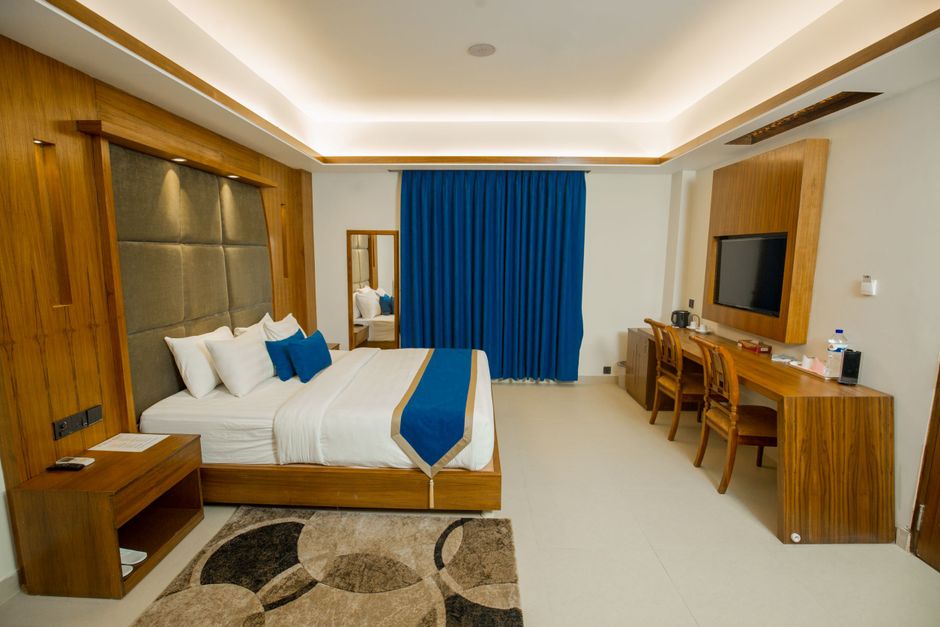
The concrete trap exists because developers treat FF&E as discretionary slack. A sophisticated asset manager treats FF&E as a rigid liability—the hotel cannot open without it, so its priority should equal that of a structural beam. Every hotel construction cost breakdown should lock FF&E as a non-negotiable line that cannot be penetrated by hard cost change orders.
3. The Boomerang Effect: Residential-Grade Substitution
When capital runs dry, the desperate move is to substitute commercial-grade hotel furniture and equipment cost with residential-grade finished goods. The savings boomerang back within 12–18 months, multiplied by lost revenue and replacement cost.

| Failure Mode | Residential-Grade Performance | Commercial (Contract) Benchmark |
|---|---|---|
| Foam collapse | 30–50% support loss within 12 months; sitting surface sags | High-density foam ≥2.5 lbs/ft³; compression set <10% after 100,000 cycles |
| Fabric wear | 10,000–15,000 Martindale fabric pills or tears in high-traffic areas within 6–12 months | 80,000–100,000 Martindale for public areas; reinforced seams |
| Frame fatigue | Light-gauge metal or softwood frames crack at joints; particleboard shelves warp | Kiln-dried hardwood or heavy-gauge steel; mortise-and-tenon joints with corner blocks |
| Finish degradation | Household finishes blister under hotel-grade disinfectants; veneer lifts in 6 months | Commercial-grade catalyzed lacquer; chemical-resistant surfaces |
| Overall lifespan | 2–3 years for visually identical chairs | 7–10 years with proper maintenance |
Sources: Atlanta Contract Furniture, LOOMLAN, Smarter Furnishings. Performance figures represent industry consensus, not a single test.

The boomerang effect in a hotel construction cost breakdown that ignores grade quality: a residential-grade chair costs 40% less upfront but must be replaced three to four times within the lifespan of one commercial-grade chair. Each replacement incurs room downtime (zero revenue that day), labor for removal and installation, and disposal fees. The net present value of that “saving” is negative.
This is not a procurement preference—it is a financial liability. Residential-grade furniture in a hotel is a contingent liability that crystallizes when the first guest complaint surfaces. Our engineering team has seen cases where a 300-key property spent $500,000 on residential furniture to save $200,000, then faced $1.2 million in replacement and lost room revenue over three years. The commercial contract furniture budget must be based on landed cost of commercial-grade products, not FOB pricing that ignores duty, freight, and durability.
4. Breaking the Cycle: Ring-Fence FF&E with Early Factory Engagement
The only financial control that works against the concrete trap is a ring-fenced FF&E account—a separate budget legally isolated from hard cost accounts. No change order from the structure side can touch it.
4.1 Three Financial Disciplines for Your Hotel Construction Cost Breakdown
- Physical segregation. The FF&E account should be managed by a different controller than the construction account. Separate bank accounts, separate approval chains.
- Early lock-in of long-lead items. Casegoods, lighting, and specialty furniture require 12–16 week lead times. Order them at the design development stage, not after the building is drywalled.
- Model on landed cost, not FOB. An FOB-only budget can understate total FF&E spend by 30% once shipping, customs, duties, and installation are included. A proper hotel construction cost breakdown must use fully loaded per-key figures.
4.2 Supply Chain Advantage: Early Chinese Contract Factory Involvement
Bringing a Chinese contract furniture manufacturer into the project during the schematic design phase allows value engineering (VE) without lowering commercial specs. At Zhobai, our engineering team works directly with the project’s architect to optimize material selection—replacing solid wood with high-grade veneer on a 30% cost reduction while maintaining BIFMA compliance. We provide third-party QC reports at mid-production and have shipped to over 40 countries. This industrial precision locks the hotel furniture and equipment cost per key from day one, removing the uncertainty that leads to budget raids.
Factory-direct procurement typically saves 20% compared to going through importers or trading companies. Those savings stay inside the ring-fenced FF&E account, building a buffer against currency fluctuation or last-minute brand standard upgrades. Physical performance testing—Martindale rub counts, foam density certification, fire resistance per CA 117 or EN 1021—is completed before mass production, so there is zero risk of residential-grade boomerang.
Return to our complete how much does it cost to build a hotel guide for the full CapEx framework, including per-key benchmarks for each category.
The data is unequivocal: every percentage point of FF&E budget lost to structure overruns erodes guest experience and long-term asset value. A rigorous hotel construction cost breakdown that separates hard assets from soft spaces is not a clerical exercise—it is the financial firewall that ensures a hotel opens at the right ADR and maintains high repeat rates. Asset managers who treat FF&E as a fixed liability from day one are the ones who deliver projects on time, on brand, and on budget.
ZHOBAI HOTEL FURNITURE
Ready to Apply These Principles to Your Project?
Our engineering team responds to all project briefs within 24 hours. Share your FF&E scope — room count, property type, target timeline, and budget range — and we’ll provide a factory-direct assessment and indicative pricing within one business day.